Hanging Around In Primary: Literacy

Showing posts with label Literacy. Show all posts

How to Teach Word Families in a Few EASY Steps

Looking for a fresh way to teach word families that actually sticks with your students?

You're not alone.

When taught strategically, word families offer a powerful way to build decoding fluency and strengthen phonics instruction. Word families have always been a go-to for building early reading skills, but how we teach and display them might need a little update.

As more classrooms shift toward Science of Reading-informed practices, it’s time to reframe how we teach word families. We can integrate routines that are interactive, engaging, and grounded in research-based instruction. Here's exactly how I teach word families using a hands-on approach that actually sticks.


1

Why You Need to Teach Sound Segmentation and the Best Way To Do It

Phonemic awareness is one of the most important skills you will teach your students. It is the ability to identify and manipulate individual sounds in words, a key component of the science of reading.

One specific aspect of phonemic awareness is sound segmentation: the ability to break words down into their individual sounds, or phonemes. This post will explore the science behind sound segmentation and how you can teach sound segmentation effectively in your classroom.

why you need to teach sound segmentation and the best way to do it.

0

Enhancing Reading Comprehension: Effective Strategies for Primary Classrooms

Why Reading Comprehension Matters in Early Literacy

As teachers, we know that reading comprehension is the key to a student’s long-term success in literacy. However, developing this skill can be challenging, especially for early readers. It’s not just about decoding words—it’s about understanding, thinking critically, and making connections while reading.


0

A Simple Way to Motivate Young Writers!

If you are a primary teacher, then you know teaching writing to young children can be HARD.  Writing is an elusive skill for many of our little ones, and they often lack the motivation to persist when it is hard.  I want to share with you a writing activity I do around this time of the year that really helps to motivate my students and get them writing more.

Help your students set goals during writing.  Work together to establish goals based on their own writing and then use this bookmark to help students keep track of their goals.  Grab a free writing goal setting bookmark to use with your students.

0

3 Ways to Maximize Learning for Busy Kids

Getting kids moving helps them learn!  If your students are like mine, it is best to keep them active so they can use up all the energy they seem to have in endless supply.  I have so many kids that seem to be in perpetual motion. So rather than working against that. I have found a way to embrace it.

Get students up and moving to maximize learning.  Let them move by having them read and write the room, use flexible seating options and brain breaks.

Click the image above to visit Hojo's Teaching Adventures Blog where I am guest blogging. You will find 3 strategies I use in my classroom to maximize learning while keeping my students active.

Until next time,
0

How to Confidently Assess Phonemic Awareness and Plan for Instruction

Colorful plastic letters beside blog title text: “Phonemic Awareness – Using Data to Drive Instruction.” Ideal for teaching phonemic awareness in K–1 with assessment-based grouping strategies.


A simple, Science of Reading-aligned system for teachers who want to stop guessing and start growing readers

You know you need to assess phonemic and phonological awareness, but you're unsure where to start.

1

Phonemic vs Phonological Awareness: What’s the Difference (and Why It Matters)

If you’ve ever caught yourself using phonemic awareness and phonological awareness interchangeably, you’re not alone. These two foundational literacy skills are closely connected—but not quite the same. Knowing the difference can make a big impact on how you support early readers. In this post, we’ll unpack the key differences between phonological and phonemic awareness, when to teach each one, and how to assess your students.
Phonemic awareness vs phonological awareness graphic with colorful alphabet letters, highlighting the difference for teachers


0

Guided Reading: How to get Students Excited About It!

Get your students excited about guided reading by using tools and tricks to increase engagements. Students will be excited to come to the guided reading group to use finger lights, reading phones and mini whiteboards.

Guided Reading is an important part of the day in a primary classroom and you want to make sure your students are excited to meet during small group. To keep your kids engaged and to make it a productive and successful guided reading time you need to be prepared.  Today I am sharing 4 things that that will get students excited about guided reading and participating in small group lessons. These tips will help keep your students motivated, excited and engaged during guide reading time.
3

5 Ways to Use Plastic Eggs to Practice Literacy Skills


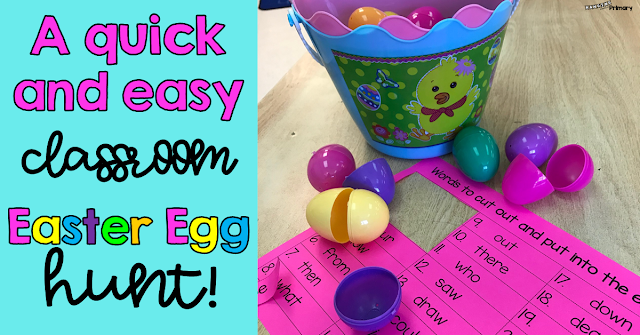
We all have them!  Those bags of plastic Easter eggs from the Dollar Store. We store them in our classroom closets waiting for the weeks leading up to Easter to break them out and use them.

Now is the time to start thinking about how to use them this year.  I am going to share 5 ways you can use your plastic eggs to practice literacy skills.  Click any of the images to take a look at the pack of recording sheets.
0

A Surefire way to Teach Students to Read and Spell Tricky Words

Do your students get stuck when reading and spelling tricky words?  My students got hung up on those rule breaker words ALL THE TIME.  What if I could show you a way to make sure those words were always spelled right?  Continue reading to learn how I introduce my words each week and more about how I use a Word Jail or Doghouse to establish dedicated practice for rule breaker words.


0

How to Engage Your Students During Guided Reading Instruction


Guided reading is an essential part of your reading time.  However, it is usually a small chunk of time each day, so you need to make the most of it and engage your students during guided reading.  So how do you do that? I will share with you 3 things you should have at your guided reading table to make your time run smoothly and help keep your students engaged during guided reading instruction.  


What is at my Guided Reading Table?


1.  Tools to teach decoding strategies

decoding strategy posters are great reminders for kids when they are stuck on a a word.  Using characters helps students better remember strategies to try.


First grade readers are decoders in their purest form.  They have learned that to read, they need to sound words out. Once they have learned their letter sounds, they are good to go, or so they think.  If you ask a first grader how to solve an unknown word, they will say “sound it out” every time.  We need to teach them that there are lots of other ways to figure out tricky words.

I do this by introducing them to the decoding strategies and the stuffed animals that go with each.  I created a set of Decoding Strategies Posters with animals to teach each strategy.  They are immediately hooked when the stuffed animals come down to the reading table as I model how to use a strategy.  For instance, when I introduce Stretchy Snake, we actually take turns coiling him up and stretching him out as we stretch out words.

However, it is not practical to keep Stretchy Snake there at all times, so I created a few student tools to go with the posters on the wall behind our guided reading table.  When working on a particular strategy, I give students the decoding wand with the character on it.  Click on any of the pictures below to get a closer look at the resource.  

Decoding strategies are key for early readers.  Having a collection of resources that students can reference during a guided group and while working independently is important too.  Using bookmarks, wands and mini cards to supplement the posters help with learning.


This acts as a reference to try that strategy when they come to an unknown word.  Later on, students can use a bookmark, which includes all the strategies, when they are more confident readers and have learned some strategies to try when decoding.

decoding strategies bookmark, beanie baby decoding strategies

I teach the decoding strategies in approximately the same order every year ~ Eagle Eye, Stretchy Snake, Chunky Monkey, Lips the Fish, Skippy Frog, Flippy the Dolphin and lastly, Tryin' Lion.

2.  Tools to teach reading comprehension

these cards are the perfect go to resource during guided and shared reading so that you always have questions on hand

When it comes to teaching comprehension skills, I have a confession to make.  Many times I struggled to figure out what exactly to ask my students or how to word it.  We do not use a particular reading series, so I glean resources from many places.

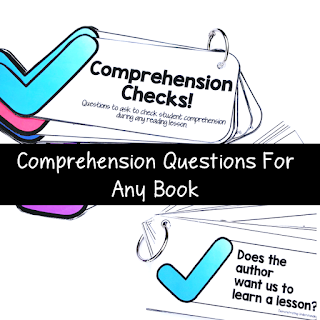
Identifying key comprehension questions for text was sometimes a bit difficult.  That is why I decided to make myself a go-to resource for any non-fiction text that covered all the different comprehension strategies that I teach.  Enter Comprehension Checks!  These question cards are placed on a ring, and I keep them at my guided reading table and another set at our carpet area to use during shared reading.  

these cards are the perfect go to resource during guided and shared reading so that you always have questions on hand

The Comprehension Checks are colour-coded and organized by reading strategy.  There are multiple questions for each strategy.  On each card, you will find the question and then “look fors” – what you might expect your students to say or think to answer the question.  This extra information makes the cards more teacher-friendly.

these cards are the perfect go to resource during guided and shared reading so that you always have questions on hand

We are about to start our unit on story elements – Character/Setting/Problem/Solution.  The Analyzing Text and Demonstrating Understanding cards will be close at hand during my guided and shared reading lessons.  Here is a closer look at a Making Connections card:

these cards are the perfect go to resource during guided and shared reading so that you always have questions on hand

3.  Tools to teach phonemic awareness

This tool isn't necessarily aimed at teaching during guided reading, but it is an essential precursor to teaching reading. In first grade, at the beginning of the year, not all of your students will be ready for a traditional guided reading group.  Instead, they need to develop foundational phonemic awareness skills to begin to decode and read the text.  In this case, teachers do not need to provide their students with books and questions, but they need to be armed with word lists and lots of them.  

practice phonemic awareness skills such as segmenting, blending, rhyming and syllables with these word lists


I always start the year with at least a couple of groups who need to start here, and I wanted to keep them engaged too during their instruction.  I created a set of word lists to practice whatever phonemic awareness skill I was working on.  I pull out the colour-coded sets and have several different word lists for each skill, so I wasn't trying to generate word lists on the fly.  We have all done that!  

use phonemic awareness word lists to practice skills like syllables, rhyming, segmenting and blending.


I hope you have found some new resources to make your guided reading time more effective and help engage your students during guided reading instruction.

Take a moment to pin this post so you can come back to it.

Need help teaching guided reading? This blog post provides many useful guided reading activities and strategies to use during guided reading. These resources will help you make the most of your time at the guided reading table. #guidedreading #guidedreadingfirstgrade

Until next time,

2

How to Use Halloween Poems to Introduce Sight Words

Students love Halloween, so why not harness that excitement by using Halloween themes to teach in October.  I created a set of easy-to-read Halloween poems for sight words to teach and review sight words all month long.  These Halloween poems also help students work on their reading fluency!  I can target many skills at once, and they totally buy in because of the Halloween theme.  


In October, I like to use Poetry to introduce sight words.  It is an excellent way for students to see the sight words in context, and the content is short and sweet.  I keep the poems quick and easy to read, so they are ideally suited to beginning readers in first grade.  You can use the poems to work on reading fluency and visualizing, so you get more bang for your curriculum buck!

Project the Poem on the Smartboard for Whole Group Learning


I have students circle the sight words in the poem - the words you are introducing and those already on your word wall. When I have students that are not yet ready to learn sight words, I ask them to circle a letter they know. This enables everyone to take part in a way that is meaningful to them.  


Use the Poem in a Pocket Chart


Turn the poem into a close activity and have your students figure out the missing sight words to make the poem make sense.  We read it repeatedly, and each time we decide on the new word, which helps build fluency.  It also helps students to use meaning cues to determine the right sight word for each spot. 

The Black Cat poem shown is available as a free download in my store.  If you love it, I have 5 more in a full set.


Multiple Worksheet Options Provide Lots of Practice! 


Use this worksheet and the others included to review so many skills:

  • Fluency
  • Finding the sight words in context
  • Visualizing and drawing a picture that matches the poem
  • Comprehension - each poem has an "in the text" comprehension question to answer. 


You can find this poem and 6 others in my poetry pack by clicking on the image below or by clicking here:

Halloween Poems and Activities for Sight Words 


Take a moment to Pin the post so you can refer to it again next year.


Until next time,


5